
Introduction: Why AR is no longer optional for home-decor e-commerce
E-commerce once meant scrolling through static JPGs and hoping color tones matched reality. Today, 72% of consumers say they expect visual accuracy when buying furniture or decor online, and they abandon stores that fall short. Yet only 14% of small retailers currently offer any AR tools, leaving a yawning experience gap — and a massive competitive opportunity.
Affordable, no-code tools like Wizart Visualization App eliminate the old barriers of price and skill; you can publish room-scale AR in an afternoon instead of a quarter. Major brands have already proven the upside: IKEA’s “Place” AR app raised purchase intent by 35%, and Houzz reported an 11× jump in conversions after adding “View in My Room.”
In 2025 the real business risk is not implementing AR, because your shoppers will simply buy from the store that does.
The visualization crisis: Challenges faced by small retailers
Three interlocking problems dog SMB decor merchants: high return rates, steep 3D production costs, and rising customer expectations shaped by retail giants. This section maps the pain points so you can benchmark your own store before leaping into solutions.
- Return rates bite margins. Home-goods returns can hit 30%, driven largely by “doesn’t match my space” disappointments. Shipping, inspection, and secondary fulfillment fees quickly erase profit.
- 3D asset cost anxiety. Traditional agencies charge about $120 per SKU to build a photorealistic mesh model — a non-starter for catalogues with hundreds of tiles, rugs, or lamps.
- Keeping up with IKEA. When market leaders normalize AR, even a beautiful static photo gallery feels outdated, eroding shopper trust and driving price wars.
The “visualization gap” is more than cosmetic — it’s a measurable drag on revenue, conversion, and customer lifetime value.
The strategic power of AR: What it really solves

Augmented reality doesn’t just look cool; it attacks the three root causes of lost sales: uncertainty, friction, and returns. We’ll unpack those benefits in two dimensions: trust conversion and ROI compounding.
AR as a trust conversion engine
Buyers crave reassurance that a sofa will fit, a tile color will pop, or a lamp’s sheen will match their fixtures. AR collapses that “imagination tax” by rendering the product inside the customer’s actual room.
- Shoppers who interact with an AR preview are 68% more likely to purchase on the same visit.
- Houzz saw 11× conversion rates among users employing its AR “View in My Room” tool.
The mere option to visualize a product in real context turns curiosity into confident checkout clicks.
AR compounds ROI across key metrics
Beyond immediate “Add to Cart” wins, AR quietly improves every downstream metric — from returns and SEO to social sharing.
| KPI | Average lift | Source |
|---|---|---|
| Conversion rate | +200–250% | Shopify merchant cohort |
| Return rate | –27% | Wizart case studies |
| Organic ranking | +15–20% | Search Engine Journal analysis |
| Social shares | 3× | Magento Experience report |
Because AR assets enrich the entire funnel, their payback period is often counted in weeks, not months.
Choosing the right AR tool: Platform fit cheat-sheet
No single vendor excels at every use-case; the best pick depends on your stack, product complexity, and budget. The matrix below maps common retailer profiles to the most appropriate solution.
| Retailer type | Best AR tool | Why it fits |
|---|---|---|
| WordPress/Woo décor shop | Wizart | One-click plug-in, wall- & floor-surface AI, <$100 /mo |
| Shopify fashion or gifts | Zakeke | Plug-and-play WebAR + virtual try-on, SaaS pricing |
| Custom furniture brand | Threekit | Advanced configurators, API, enterprise support |
| B2B lighting supplier | Augment | CAD/STEP support, field-sales viewer |
Match your technical comfort and catalogue needs first; bells and whistles mean nothing if integration stalls.
Implementation framework: Phased AR deployment for SMEs
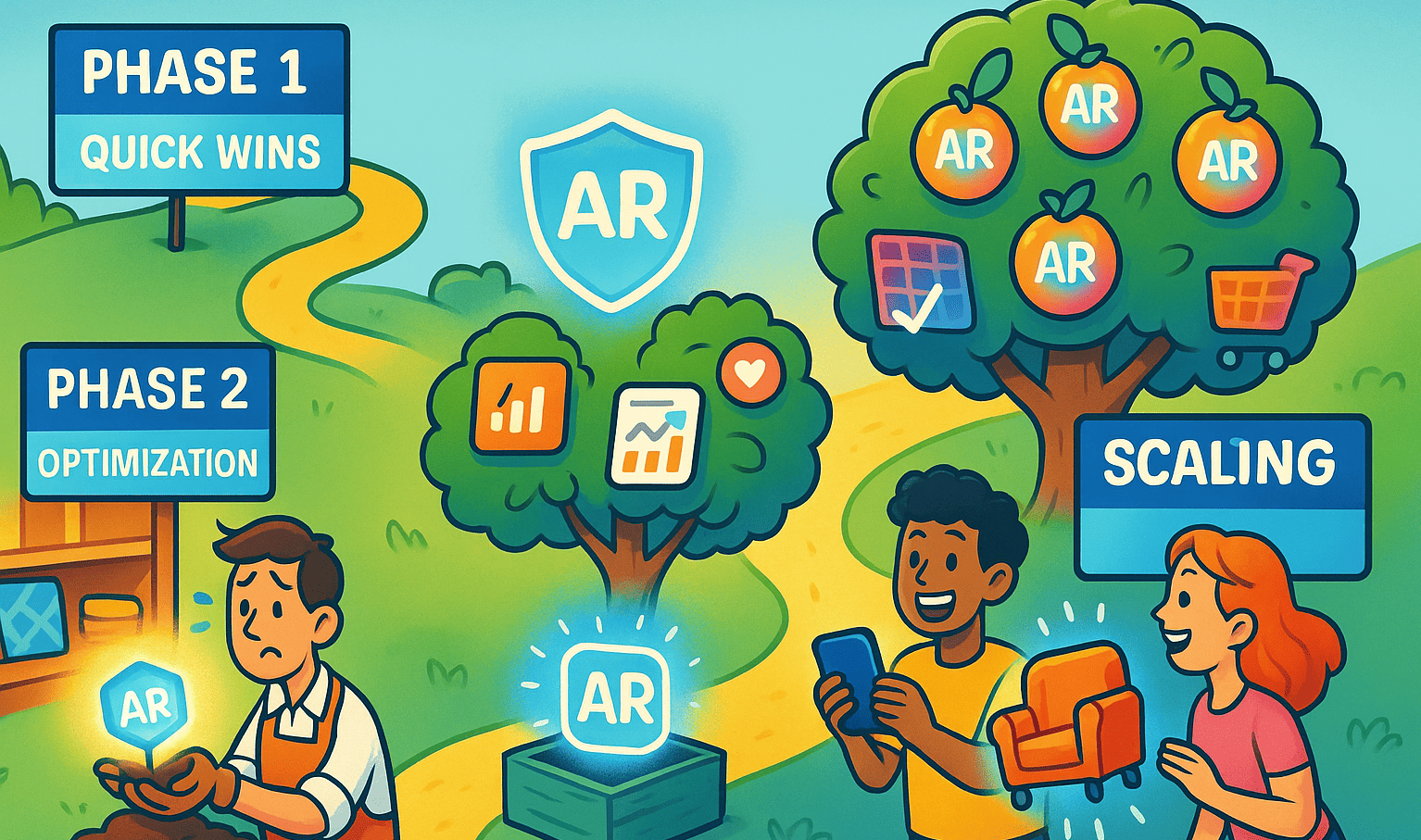
Rolling out AR in a big-bang launch can overwhelm teams and budgets. A phased approach — quick wins, optimization, then scale: lets you fund each stage with the gains of the last.
Phase 1 · Quick wins (0–2 months)
This sprint proves ROI fast by targeting the SKUs that hurt you most through returns or low conversion.
- Install the Wizart plug-in on WordPress 5.5+.
- Identify the 10 SKUs with the highest return counts via GA4 reports.
Phase 2 · Optimization (3–6 months)
Once proof positive, extend AR to a quarter of your catalogue and weave it into off-site channels.
- Expand coverage to 25% of SKUs — the tipping-point Forrester flags for noticeable revenue lift.
- Insert WebAR links in email flows and Instagram posts; Zakeke auto-generates the embeds.
- Analyze heat-maps in the Wizart dashboard to A/B-test hotspot interaction.
Phase 3 · Strategic scaling (6–12 months)
Now AR becomes a cornerstone of personalized merchandising and omnichannel marketing.
- Layer Threekit’s AI-guided selling to auto-suggest finishes or bundle deals based on interaction data.
- Publish branded Instagram/TikTok AR filters; Meta records 27% higher CTR for AR ads.
- Wrap each model in
<model-viewer>markup plus Product schema; Search Engine Journal notes 15-20% ranking gains.
Each phase self-funds the next, de-risking investment while accelerating growth.
Case study: AR turnaround for a tile retailer
“Mediterraneo Tiles,” a 1,200-SKU WooCommerce shop, illustrates how even niche sellers can capture AR upside in under a year.
| KPI | Before AR | 9 months after Wizart | Change |
|---|---|---|---|
| Return rate | 20.4% | 14.8% | –27% |
| Mobile conversion | 1.8% | 4.3% | +139% |
| Organic traffic | Baseline 100 | Index 225 | +125% |
The retailer began with ten mosaic tiles notorious for color returns. After AR went live, customer-service tickets on “color mismatch” fell by half within six weeks. The owner then rolled AR to 600 SKUs, syndicated WebAR links to Pinterest Idea Pins, and optimized product schema — vaulting a page-three keyword (“Mediterranean tiles”) to page one.
Incremental deployment turned AR from a cost center into a compounding growth engine.
Advanced insights: AR as a foundation for future commerce

WebAR is effectively ubiquitous
The need to download a separate app was the biggest adoption hurdle — now it’s obsolete.
Browser-based AR guarantees reach across both iOS and Android without extra dev time.
AI-driven 3D content creation
Neural Radiance Fields (NeRF) and diffusion models decimate the cost and time of traditional mesh modelling.
- AR Insider notes NeRF workflows trim 3D build times by up to 90% and drop per-SKU costs below $20.
- By the way, 3D modelling requires textures and much more time investing..
As AI erodes production costs, AR’s ROI climbs even higher.
Social AR and omnichannel impact
AR isn’t just a product-page gimmick; it fuels content that travels across TikTok, Instagram, and even brick-and-mortar displays.
- Magento merchants saw 3× more social shares from posts that embedded AR previews.
- Meta’s Spark AR data shows Instagram AR ads deliver 27% higher CTR over flat creative.
AR content acts as a viral flywheel, amplifying reach without additional ad spend.
Actionable takeaways
If you skim only one section, make it this checklist — five moves any WordPress decor merchant can queue up today.
- Start with pain-point SKUs. Attack high-return or high-AOV products first.
- Use plug-ins, not custom code. Wizart (WP) or Zakeke (Shopify) install in minutes.
- A/B-test everything. Split PDP traffic 50/50 to quantify AR lift in conversion and bounce.
- Incentivize UGC. Offer a loyalty-point bonus for customers who post AR screenshots.
- Feed search engines. Add 3D schema so Google can surface your model in Rich Results.
Small, consistent optimizations compound quickly — especially when they ride the tailwind of better shopper confidence.
Conclusion: AR as business essential, not tech gimmick

AR has crossed its Rubicon: from futuristic novelty to baseline expectation. The merchants who embed it today secure an enduring edge in trust, SEO, and social reach.
Affordable SaaS tools erase the historical barriers of cost and expertise, while AI slashes 3D production overhead. Case studies confirm the financial upside; industry data proves shoppers demand it; and WebAR ubiquity ensures smooth delivery.
In E-commerce’s next chapter, winning shops won’t compete on price alone, they’ll compete on experience. Augmented reality is the fastest, most direct way to deliver that experience now.